Lesson 1: Auditory Attention and Visual Tracking


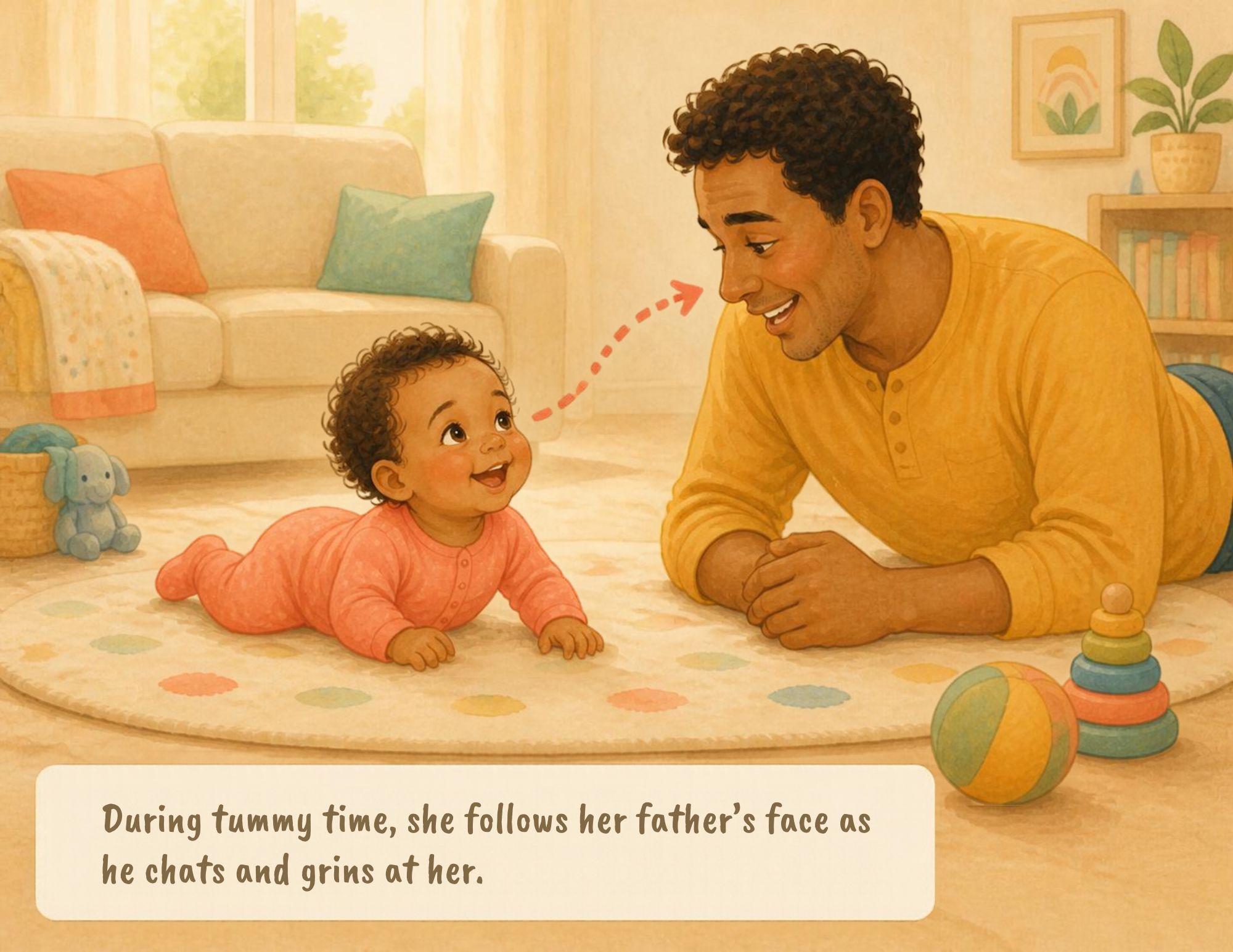

Amira’s parents notice she quiets and smiles when they softly sing her name. During tummy time, she follows her father’s face as he chats and grins at her. These small, loving moments are helping Amira’s brain grow and learn to focus on voices and faces. This matters for language arts development because paying attention to sounds and faces is the first step toward listening, understanding, and eventually communicating with words.
Aims:
Introduce your baby to the world of sounds and sights and nurture awareness and curiosity.
Introduce your baby to the world of sounds and sights and nurture awareness and curiosity.
Goals:
- Encourage awareness of voices and environmental sounds.
- Support visual focus on faces and high-contrast objects.
Objectives:
- Turn toward familiar sounds.
- Follow bold images or faces with eyes.
Transformation:
Your baby shifts from passive observation to active engagement with their environment.
Your baby shifts from passive observation to active engagement with their environment.
Foundation:
Babies are born ready to listen and look and prefer voices and bold patterns.
Babies are born ready to listen and look and prefer voices and bold patterns.
What Happens Next:
This lays the groundwork for recognizing caregivers’ voices and forming social connections.
This lays the groundwork for recognizing caregivers’ voices and forming social connections.
Skill Progression:
- Auditory attention
- Visual tracking
Activities List:
- Gently shake a rattle or bell from different sides and watch for your baby’s response.
- Hold your baby close, make gentle sounds, and maintain eye contact.
- Show black-and-white cards or bold patterns, slowly moving them across your baby’s line of sight.
Materials:
Rattles, bells, high-contrast cards, your face/voice
Differentiation:
- For hearing concerns, pair with gentle touch or vibration.
- For visual impairments, use sound and touch instead.
Integration:
- Narrate diaper changes and feedings (“Now we’re putting on your shirt!”)
- Sing softly while rocking your baby.
Parent Simulation Tip:
Try gentle sound games in everyday routines—bath time, getting dressed, stroller walks.
Try gentle sound games in everyday routines—bath time, getting dressed, stroller walks.
Interactive Activities:
- Individual: Caregiver sings and makes faces
- Group: Siblings or family members take turns talking or singing to baby.
Activity Pack: Please print the accompanying activity pack for this lesson.