When Life Feels Like Too Much: How BCC Helps Your Children Build Bigger Bowls — A Guide for Parents
At the Biblical Coaching Center (BCC), our focus is on helping children and teens build the resilience they need to handle life’s challenges. While we do not address long-term trauma effects, it’s important for parents to understand what trauma is and how it can affect children.
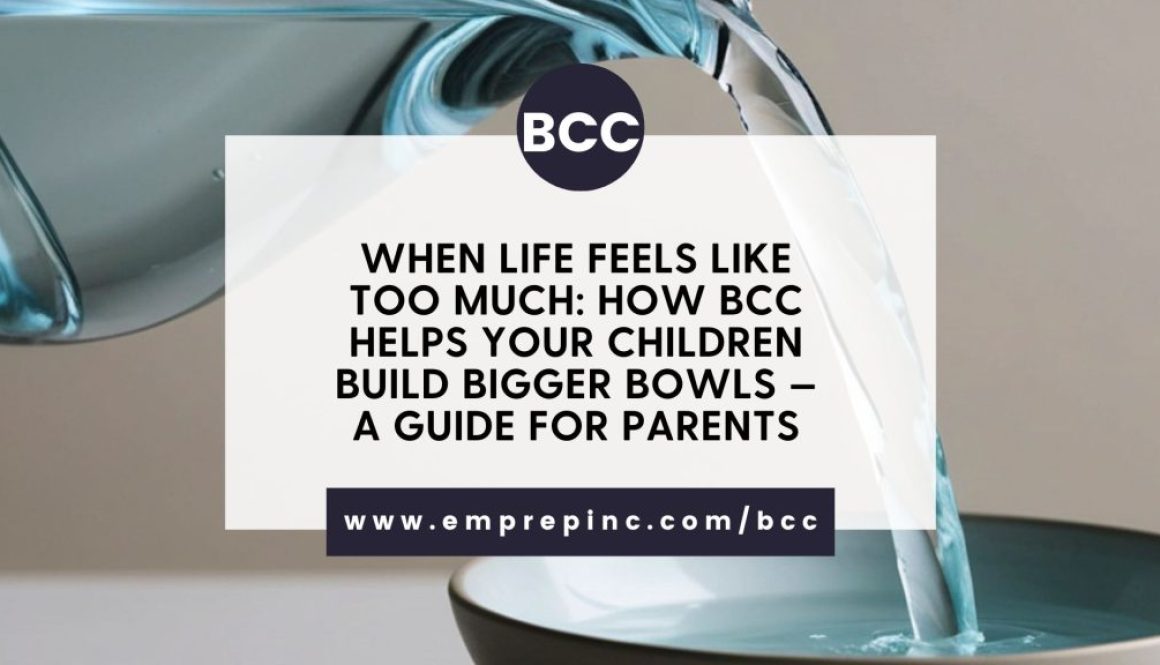
Picture two bowls—a small one and a big one—and two identical pitchers of water. The water is a difficult event; the bowls are your child’s mind. Pour water into the small bowl, and it quickly overflows. This overflow is trauma: the experience is too much for the child’s mind, causing overwhelm.
Now, pour the same amount of water into the bigger bowl. Even as it fills up and may seem scary as the water nears the top, it doesn’t overflow. That’s resilience—the ability to adapt and contain difficult experiences without becoming overwhelmed. At the BCC, we help your children, with your permission, enter a safe space and build resilience so they can better handle life’s challenges.
What is Trauma?
Trauma happens when a child experiences something so frightening, overwhelming, or upsetting that it exceeds their ability to cope. This could be an accident, a loss, abuse, witnessing violence, or chronic stress or neglect. When trauma occurs, a child’s mind and body can go into “survival mode,” which can impact how they think, feel, and behave—sometimes even long after the event.
Trauma happens when a child experiences something so frightening, overwhelming, or upsetting that it exceeds their ability to cope. This could be an accident, a loss, abuse, witnessing violence, or chronic stress or neglect. When trauma occurs, a child’s mind and body can go into “survival mode,” which can impact how they think, feel, and behave—sometimes even long after the event.
How Trauma Shows Up in Children
You might notice changes such as trouble sleeping, increased anxiety or withdrawal, mood swings, or acting out in new ways. Some children may seem jumpy, irritable, or have difficulty trusting others. Trauma can also make it hard for children to focus in school or enjoy things they once loved. These reactions are not signs of weakness or misbehavior. They are ways your child’s mind and body try to cope with something that feels too big or scary to manage.
You might notice changes such as trouble sleeping, increased anxiety or withdrawal, mood swings, or acting out in new ways. Some children may seem jumpy, irritable, or have difficulty trusting others. Trauma can also make it hard for children to focus in school or enjoy things they once loved. These reactions are not signs of weakness or misbehavior. They are ways your child’s mind and body try to cope with something that feels too big or scary to manage.
How the BCC Makes a Difference
What we do at the BCC is help children and teens build resilience by walking alongside them as they face the smaller challenges of life. We help them build their coping skills. When they say, “No, I can’t do it,” or “I don’t know how to do it,” we say, “You can do it. Here’s how.” That’s why we want to hear their stories—through letters or anonymously—so we can offer a coaching program that shows them, step by step, how to walk through it. Our goal is to help them build their capacity to cope and move forward.
Although we cannot predict what will happen next, we can help them be as prepared as possible to navigate the really hard parts of life. They have bigger things to do in life, and feeling stuck or not living to their fullest potential should not be an option. Every child and teen has so much more to give. Give them the gift of what we offer at the BCC.
References:
- van der Kolk, B. A. (2014). The Body Keeps the Score: Brain, Mind, and Body in the Healing of Trauma. Penguin Books.
- National Child Traumatic Stress Network (NCTSN). (n.d.). What is Child Trauma? https://www.nctsn.org/what-is-child-trauma
- Perry, B. D., & Szalavitz, M. (2017). The Boy Who Was Raised as a Dog: And Other Stories from a Child Psychiatrist’s Notebook. Basic Books.
These resources help you learn more about trauma’s effects on children and ways to support them as they heal.